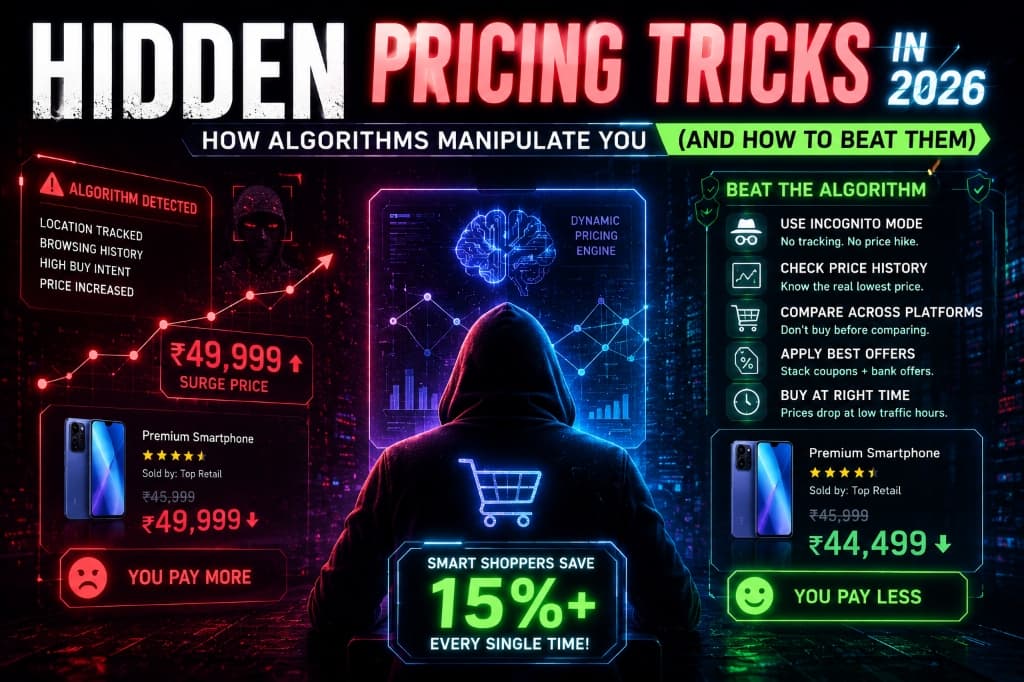
"From 'Surge Pricing' for recurring visitors to 'Dark Patterns' that hide better deals, e-commerce giants use sophisticated AI to maximize their profit at your expense. This guide exposes the hidden pricing tricks of 2026 and provides the ultimate 'Loot Blueprint' to get the absolute lowest price every time."
The War on Your Wallet: The Rise of Algorithmic Pricing
In 2026, shopping online isn't just about clicking 'Buy Now.' It’s a psychological and technical battle. Platforms like Amazon, Flipkart, and Myntra no longer have static prices. Instead, they use Dynamic Pricing Engines that adjust the cost of an item in real-time based on your location, device, browsing history, and even your battery level.
Have you ever noticed the price of a laptop jump by ₹500 just as you were about to checkout? That wasn't a coincidence. That was the algorithm detecting your 'High Intent to Buy' and testing your willingness to pay more.
Surge Pricing & The Recurring Visitor Trap
Just like Uber or Ola, e-commerce platforms now use surge pricing. During peak hours (usually 8 PM to 11 PM in India), prices on high-velocity items like phone chargers, fashion basics, and skincare often creep up.
Why this happens:
- Scarcity Simulation: The site shows 'Only 2 left in stock' (even if there are 200) to trigger FOMO.
- Regional Surge: If thousands of people in Bangalore are looking at the same air purifier during a pollution spike, the price will automatically rise for that region.
 AI Pricing Algorithms Explained
Exposing 'Dark Patterns' in 2026
Despite regulatory crackdowns, platforms have become subtle with 'Dark Patterns'—design choices meant to trick you into spending more.
- The 'Confirm Shaming' Tactic: Ever seen a button that says 'No, I prefer to pay full price' instead of a simple 'No thanks' for a protection plan? That’s psychological manipulation.
- Drip Pricing: The price on the search page is ₹999, but by the time you add 'Secure Packaging,' 'Platform Fee,' and 'Convenience Fee,' it’s ₹1,150.
- The Hidden 'Cheapest' Seller: Platforms often prioritize the seller who pays for 'Sponsored' placement over the one who actually has the lowest price.
The Loot Blueprint: 5 Tactics to Beat the Machine
Ready to strike back? Use these verified 'Loot' tactics to force the algorithm to give you the best deal.
1. The Multi-Device Delta
Check the price on your Phone App, your Laptop (Chrome), and a Tablet. In 2026, 'Mobile Only' discounts are common, but sometimes the Desktop site misses a price hike that the App has already applied.
2. The Incognito Final Move
Never buy from your main logged-in session for the first time. Check the price in an Incognito window. If the price is lower, the platform is 'Surging' you based on your history.
3. The 'Cart Cooling' Strategy
Add the item to your cart and leave it there for 12 hours. The AI’s 'Retargeting Engine' will likely detect a 'Dropped Lead' and send you a notification with an exclusive coupon to 'nudge' you back.
4. Use Browser Extension Aggregators
Tools like Keepa and PriceHistory are your best friends. They show you the actual price floor over the last 365 days. If the current 'Sale' price is higher than the price two months ago, don't buy.
5. VPN Price Arbitrage (Advanced)
Sometimes, prices for digital services (YouTube Premium, Netflix, etc.) or travel vary by city. While less common for physical goods, it's worth checking if a different 'Delivery Pincode' changes the base price.
Conclusion: Be a Hunter, Not a Victim
The e-commerce platforms spend millions on AI to take your money. Dashing Loots spends hundreds of hours teaching you how to keep it. By understanding these hidden pricing tricks, you can save an average of ₹10,000–₹15,000 annually simply by shopping smarter.
The Golden Rule: If you feel rushed to buy, the algorithm is winning. Take a breath, use the blueprint, and secure the loot.